

How to Build a Consistent AI Influencer Series

Imagine a fictional street-dance teacher named Nia. Her Monday portrait shows a long dark braid and a narrow teal sleeve stripe; by Friday, a new video prompt has given her loose curls and a different face. A new outfit would be harmless, but a new face makes her look like someone else, and that breaks the series.
A consistent AI influencer needs an approved identity that survives a change of scene and format.
The working order is simple: define what viewers should recognize, choose one reference portrait, plan the posts, and reject any candidate that fails a human comparison. That review is the editor’s job, because a generation prompt cannot promise the result.
Chapters
Define a Consistent AI Influencer’s Identity

AI character consistency suffers when each post starts from a fresh description. One prompt might mention a braid; the next focuses on a backdrop and omits it. For Nia, the editor writes a short AI influencer persona sheet before requesting weekly content. The team keeps it as an ordinary working document and does not assume the image tool saves it.
Record the visible traits that matter: face shape, hair color and arrangement, build, and one distinctive accessory. Give the character a content niche and a boundary for what she may claim. Nia teaches invented dance combinations, so her posts must never read as a real student’s testimonial or an actual class announcement. That rule governs the copy as much as the pictures.
Leave room for change. Jacket, angle, lighting, and background can vary; a different face cannot. A permanent costume would also make the series repetitive. Decide which details signal identity and which belong to this week’s scene. A wardrobe guide helps, but adjectives will not substitute for looking at outputs.
Fix One Portrait as the Reference
The first production decision is to approve a single portrait. WaveSpeedAI’s Influencer Studio offers original fictional characters and presets as a way to create a consistent AI influencer. Its FAQ says the character portrait is sent as a reference for each photo and video, with the models asked to maintain the face, hair, and body. That is an input plus an instruction to the models, so the editor still has to inspect every result before accepting it as the same character.
For the hypothetical Nia series, choose a clear portrait with the braid, face, and build visible. Save that approved image beside the persona sheet, and use it as the comparison point for every candidate. If a lovely image changes her jaw or turns the braid into a short haircut, archive it as a rejection rather than quietly redefining Nia around the latest output. The reference is useful only while it remains fixed.
The same discipline works without an AI character tool. A consenting performer can be photographed for recurring posts, with ordinary editing used to keep the visual identity stable. Get agreement before using a real person’s portrait as source material. Nia is wholly fictional, so there is no identifiable likeness to borrow.
Plan Three Posts From One Portrait
A weekly plan changes the scene and format while keeping the character. Nia’s proposed Monday still could show a rehearsal space. The proposed Wednesday clip places her before the camera to explain a basic step; the Studio page lists talk-to-camera clips among its examples. Friday might be a movement clip. WaveSpeedAI’s Showcase includes dance and dance-tutorial concepts, but those examples do not make a dependable dance result a given for Nia.
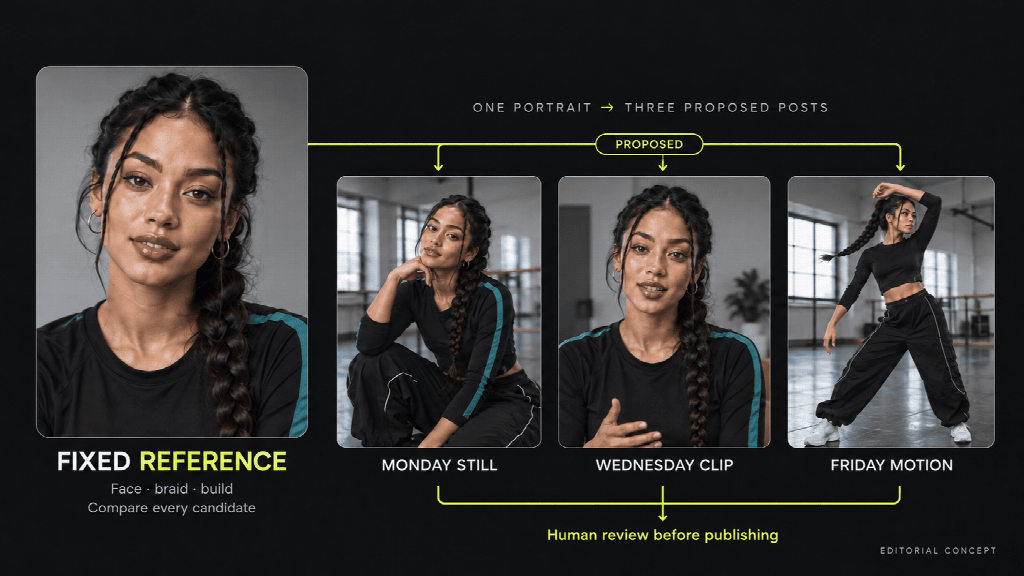
One fictional portrait anchors three proposed post concepts; an editor still checks each candidate before publishing.
| Proposed post | Change on purpose | Keep from the portrait | Editor’s check |
|---|---|---|---|
| Monday still | Location and crop | Face, braid, build | Enlarge the face beside the approved portrait. |
| Wednesday talk-to-camera clip | Topic and framing | The same character reference | Inspect opening, middle, and final frames; check mouth and hands. |
| Friday movement concept | Motion and backdrop | Recognizable facial and hair traits | Reject a changed identity or broken motion before posting. |
These are hypothetical assignments, not finished assets or an automatic posting queue. A series may need several candidates for one approved post. Count approvals, not attractive previews. If Friday’s motion is unusable, a still or simpler clip is better than publishing a broken dance because it was on the calendar.
Review the Face in Stills and Moving Frames
Put the reference portrait and a candidate still side by side at similar display sizes. Compare the face before looking at the palette or background. Hair, build, and the chosen identifying detail come next. This order prevents a matching outfit from disguising a new face. Then inspect the full frame for distorted hands, unintended people, stray text, or an implausible setting.
Video needs a different pass. A strong opening frame says little about a turning head halfway through a clip. Pause near the beginning, middle, and end; add another stop where the face turns or the hands cross the body. At each stop, ask whether a viewer would still recognize Nia; one thumbnail that resembles the portrait proves little. Check the mouth against any spoken line, then compare those words with the proposed caption. An editor can reject a clip without any automatic percentage score.
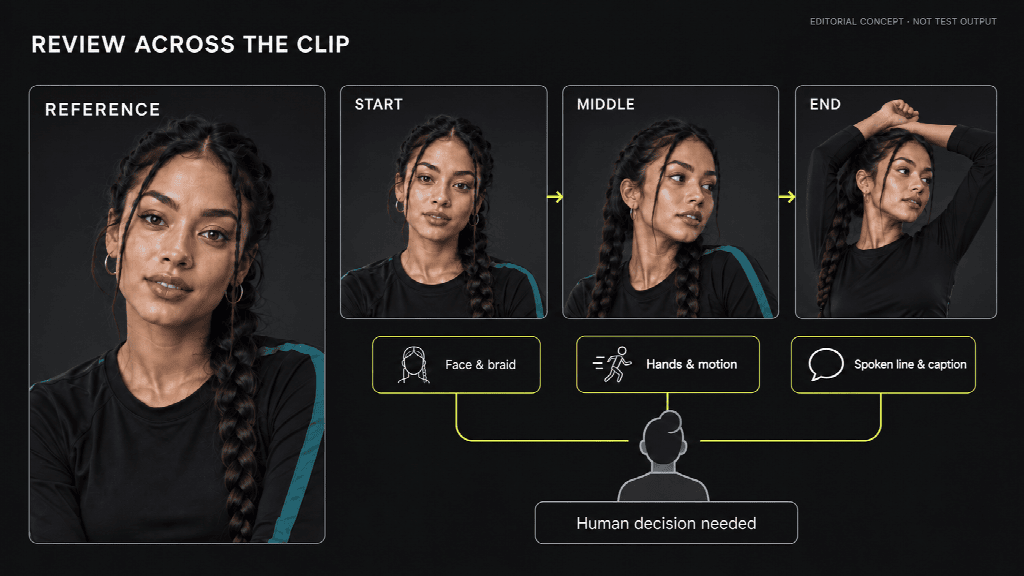
Record the decision in plain language: “hair changes at the turn,” “extra hand appears,” or “spoken claim has no source.” A reject log tells the next editor what to watch for and stops the team from recycling a flawed clip because its first frame looked good.
Sometimes the simplest fix is a creative one: drop the difficult movement and change the shot, instead of requesting it again and hoping the tool repairs it.
Check the Post’s Identity and Disclosure
Trust in virtual influencer content also depends on the caption and spoken lines. Nia can be a fictional dance character without pretending to be a real teacher, customer, or witness. Review the caption, spoken lines, and any overlaid words for that confusion. A personal account of attending an actual class would be false in this hypothetical series; a plainly fictional movement demonstration is a different proposition.
Before publishing, the publisher checks each destination platform’s current rules for AI-generated imagery, video, and identity labels, then applies the label and wording that fit the actual post. If a script makes a factual claim about a real person, place, or event, confirm it from a source before it leaves the draft folder.
Keep the Approved Reference for the Next Post
After a post is approved, store four things together: the persona sheet, original reference portrait, approved asset, and reason any close alternatives were refused. Add the planned caption and destination platform so the next editor sees the intended context. This small version log can live in any ordinary team folder. Influencer Studio does not list an approval system or scheduling calendar, so the team keeps this record itself.
When Nia’s next assignment arrives, open the reference and the reject log before writing a new scene prompt. If a proposed look changes her recognizable face or braid, hold the post even when the background looks better than last week’s. The series stays consistent because an editor makes that same decision for every candidate.
Other Interesting Articles
- AI LinkedIn Post Generator
- Gardening YouTube Video Idea Examples
- AI Agents for Gardening Companies
- Top AI Art Styles
- Pest Control YouTube Video Idea Examples
- Automotive Social Media Content Ideas
- Plumber YouTube Video Idea Examples
- AI Agents for Pest Control Companies
- Electrician YouTube Video Idea Examples
- How Pest Control Companies Can Get More Leads
- AI Google Ads for Home Services
- 60-Second Training Videos Are the New Corporate Standard
- Cybersecurity PR Pricing: Retainers, Deliverables & ROI
- Best AI Tools for Product Consistency in E-Commerce Video
Master the Art of Video Marketing
AI-Powered Tools to Ideate, Optimize, and Amplify!
- Spark Creativity: Unleash the most effective video ideas, scripts, and engaging hooks with our AI Generators.
- Optimize Instantly: Elevate your YouTube presence by optimizing video Titles, Descriptions, and Tags in seconds.
- Amplify Your Reach: Effortlessly craft social media, email, and ad copy to maximize your video’s impact.
The post How to Build a Consistent AI Influencer Series appeared first on StoryLab.ai.
Deixe um comentário