

Common Traits of Content That Supports the Sales Funnel
Content marketing costs 62% less than traditional marketing and generates nearly three times the leads. That stat gets quoted a lot, usually to convince someone to start a blog. But the pitch skips the harder part, and that’s that most content doesn’t actually do what it’s supposed to do.
There’s a lot of content out there that reads fine, ranks okay, and then sits there like a waiting room magazine. People flip through it and leave. It doesn’t trigger any actions, follow-ups, or sales.
Successful businesses that get real results from content don’t focus on producing as much content as possible. They’re just smart enough to know that they need content that’s built around where a buyer actually is in their decision process. That alignment is what separates content that supports sales from content that supports nothing in particular.
This article breaks down what that alignment looks like in practice.
Chapters
It Educates Before It Tries to Persuade

Most people buy from content that helps them understand something first. They don’t get anything from content that pushes them to buy.
We’re not being philosophical here. This is a measurable stance. Educational content makes consumers 131% more likely to convert compared to promotional material. Readers who feel informed make decisions faster and with more confidence, and that confidence tends to point toward whoever educated them.
The practical shift here is simpler than it sounds:
- Instead of leading with your product, lead with the problem or question your buyer already has.
- What are they Googling before they even know your brand exists?
- Start there. Answer that question completely and without steering every sentence toward a sale.
- The pitch, if there needs to be one, earns its place at the end.
A few ways to make this work in practice:
- Write comparison pieces that genuinely weigh both sides.
- Create explainer content around category-level questions your audience asks.
- Resist the urge to insert CTAs before the reader has gotten any real value.
- Let the education do the heavy lifting first.
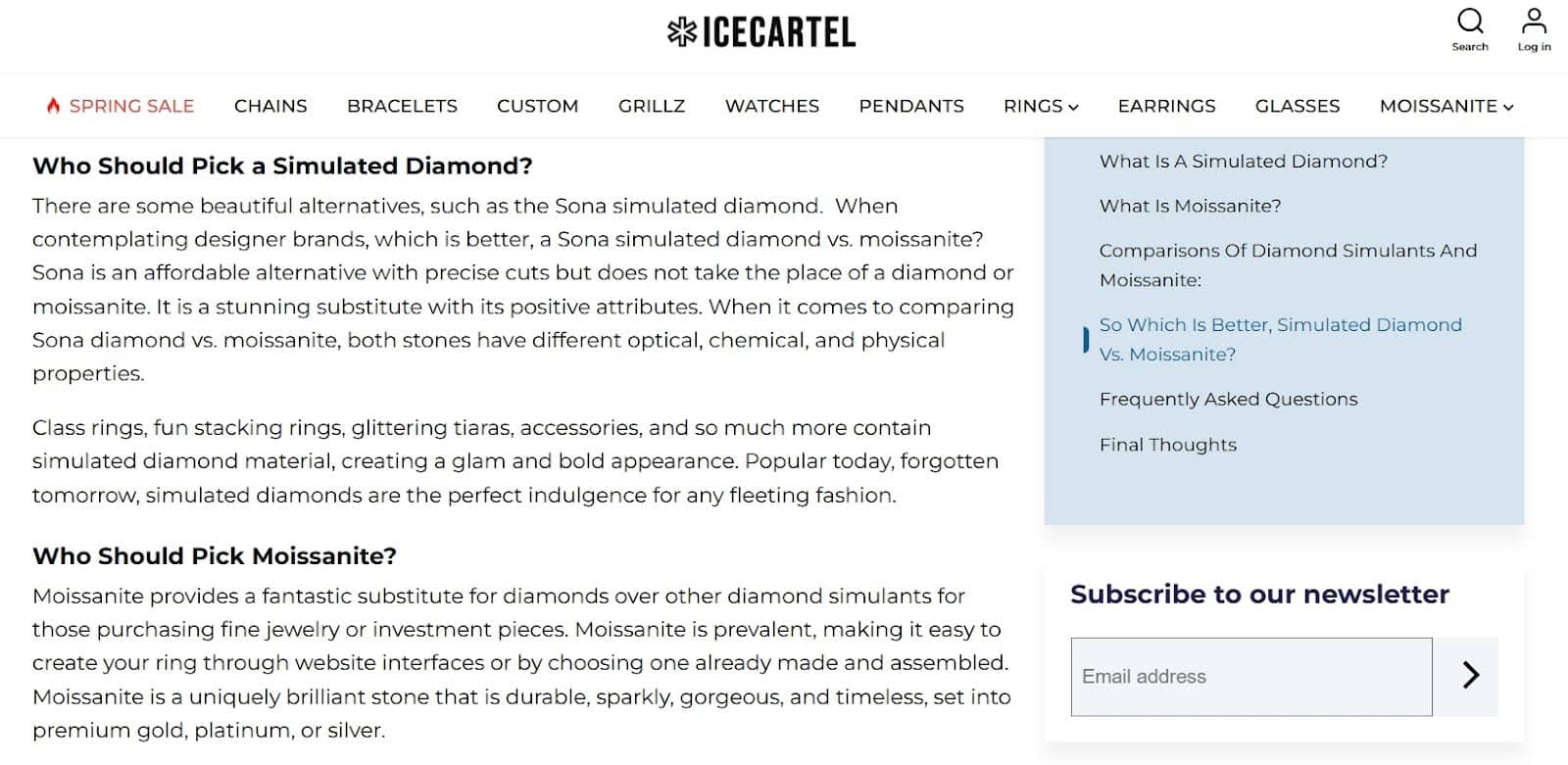
A brand that does this exceptionally well is Icecartel, a men’s fine jewelry brand specializing in moissanite and alternative stones. Their blog post “Simulated Diamond vs. Moissanite: A Side-by-Side Comparison” walks readers through the actual differences between the two materials, like cost, appearance, and durability.
They do this without framing everything around a purchase. Someone landing on that page is likely early in their buying process, still figuring out what they even want. By the time they’ve finished reading, they understand the category better, and Icecartel is the brand that got them there.
That’s the position you want to be in. Not the loudest voice, but the most useful one at the right moment.
Source: icecartel.com
It Anticipates and Addresses Buyer Hesitation
Every buyer, at some point before converting, hits a wall of doubt. They ask themselves: Is this the right product? Is there something better out there? Am I missing something?
Most brands respond to that silence by pushing harder. The smarter move is to meet those questions head-on before the reader even has to ask them.
Hesitation rarely comes out of nowhere. It follows predictable patterns, such as price concerns, comparison shopping, skepticism about claims, or uncertainty about fit. If you’ve sold anything for long enough, you already know what your buyers are worried about. That knowledge is content waiting to be written.
Here’s how to put it to work:
- Map out the three to five objections that come up most often in your sales process or customer reviews.
- Then, build content around each one.
- Don’t dodge the hard questions. Answer them directly.
- If a competitor does something better in a specific area, say so, and then explain where your product wins. That kind of transparency builds trust faster
- than any amount of polished copy.
- Comparison content, FAQ pages, and “alternatives” articles are especially effective formats for this because they intercept buyers at the exact moment they’re weighing their options.
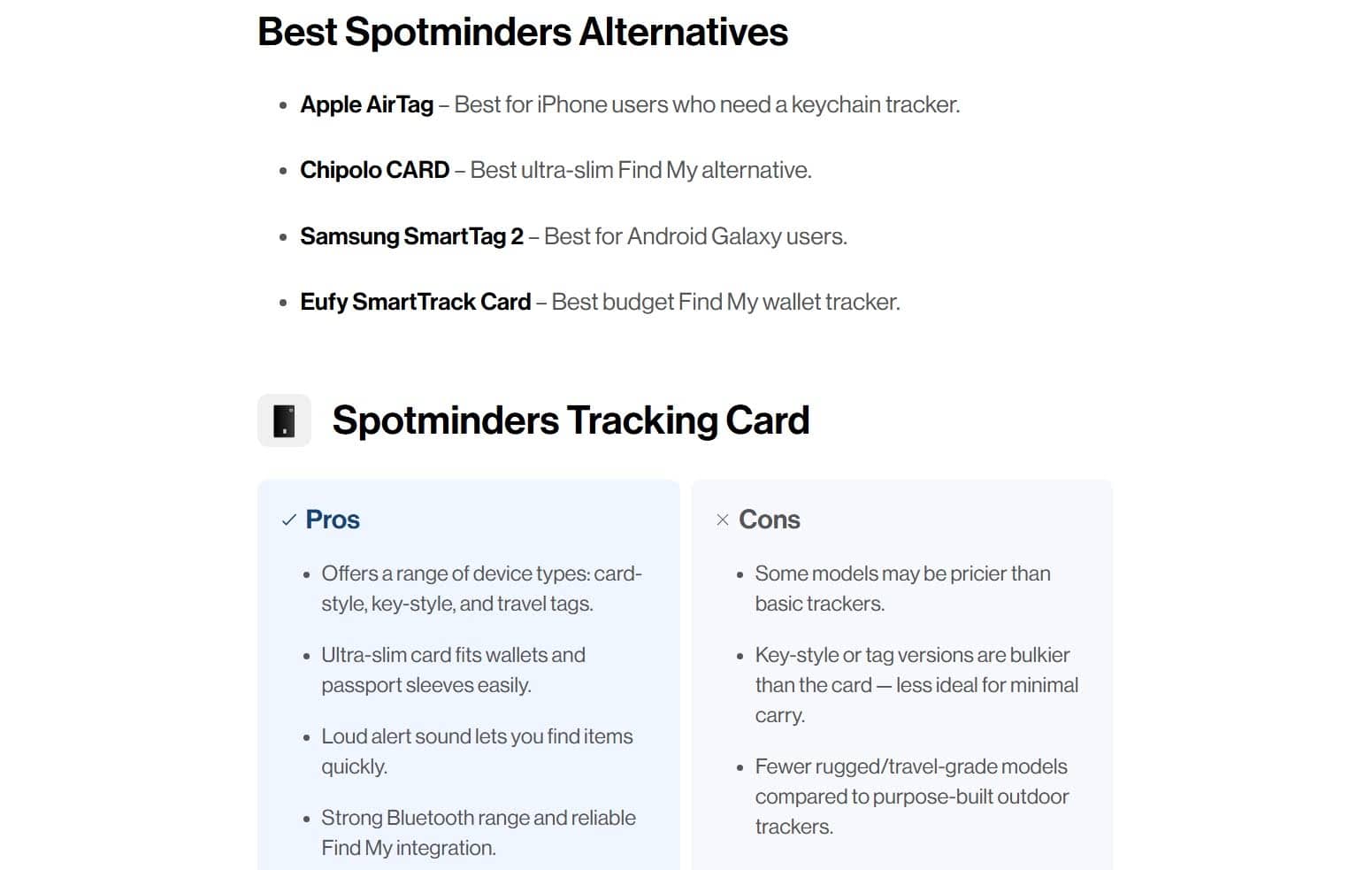
Spotminders, a brand that makes ultra-slim tracking solutions for everyday items like wallets and bags, takes this approach with their blog post “Best Alternatives to the Spotminders Tracking Card.”
Rather than avoiding the comparison, they walk readers through competing options with enough honesty to feel credible. Someone researching that category lands on the page mid-hesitation and leaves better informed.
This allows Spotminders to position themselves as the brand confident enough to have that conversation. That confidence is what makes the content convincing.
Source: spotminders.com
It Builds Trust Incrementally, Not All at Once
Nobody hands over their money or loyalty after a single interaction. Trust gets built across multiple touchpoints, and content is one of the most consistent ways to stack those touchpoints over time.
It’s no surprise that trust and credibility rank as the top return businesses see from content marketing. The brands that understand this stop treating every piece of content as a closing argument and start treating it as a deposit.
The accumulation is the strategy. One helpful article doesn’t make someone trust you. Ten does. And the way you get to ten is by consistently showing up with content that’s accurate, useful, and free of an obvious agenda.
Here’s how to do this:
- Diversify the types of content you publish.
- Mix category-level education with product-specific detail, behind-the-scenes transparency, and expert-driven explainers.
- Cover topics adjacent to your product, not just the product itself. When readers keep finding useful answers on your site across different searches and different moments, that pattern registers as authority.
- You’ll also be better off by resisting the urge to monetize every paragraph. Not every post needs a CTA. Some content just needs to be good.
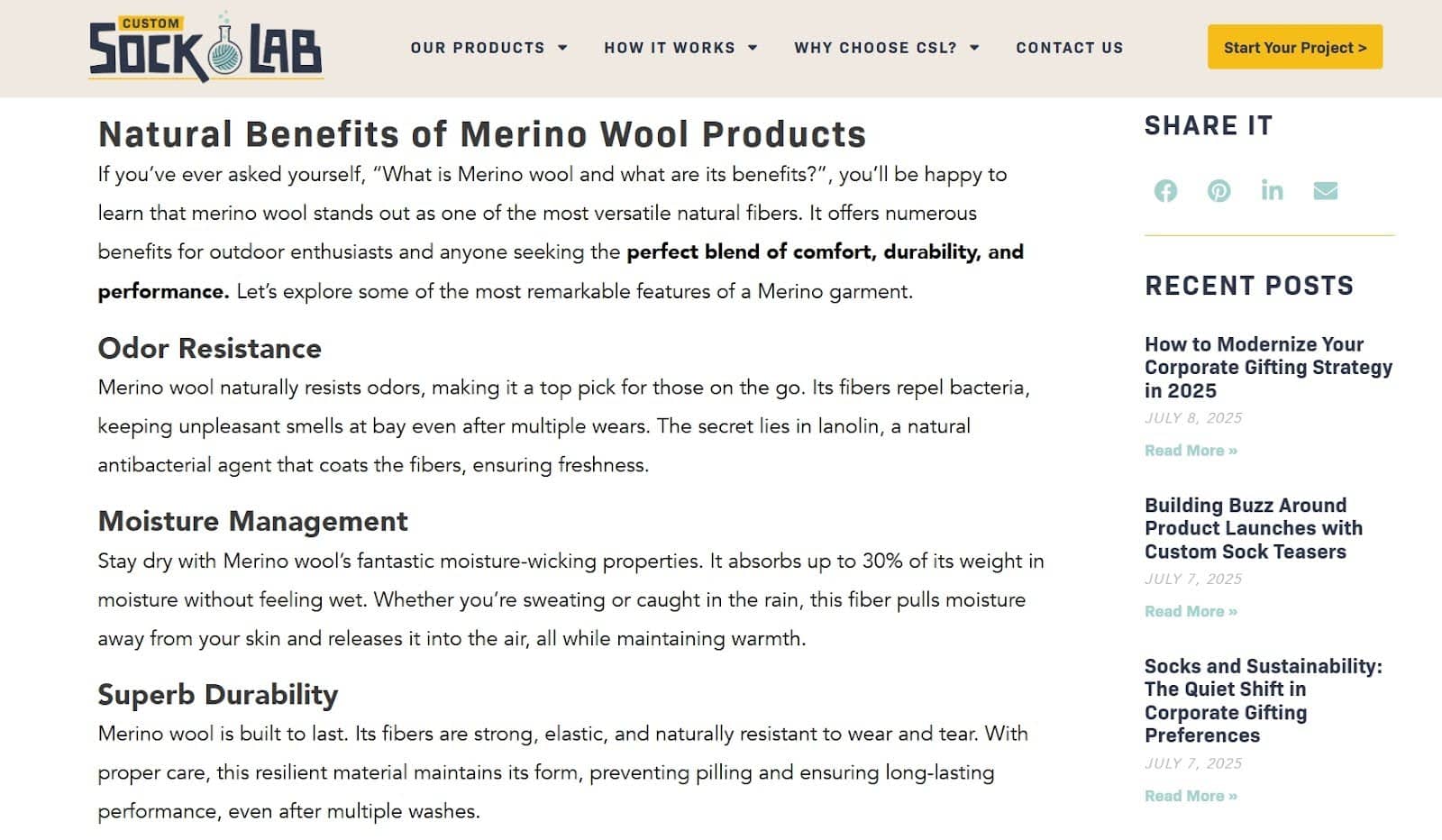
Custom Sock Lab, a brand that produces custom socks for both businesses and personal use, applies this well.
Their post “What is Merino Wool? The Complete Guide and Its Unique Qualities” doesn’t mention a product push. It explains the material, its properties, benefits, and practical applications in a way that’s genuinely informative.
A reader lands there, curious about fabric, and leaves with a clearer understanding, and Custom Sock Lab earned a small but real piece of credibility in the process.
That’s how trust compounds.
Source: customsocklab.com
It Meets Buyers at the Right Stage of Awareness
Not every reader is in the same place. Some have never heard of your brand. Some are actively comparing options. Some are one answered question away from buying.
Content that ignores those differences tends to either talk over people’s heads or bore them with information they already have. Matching content to where a buyer actually is in their process is what makes it useful, and useful content is what moves people forward.
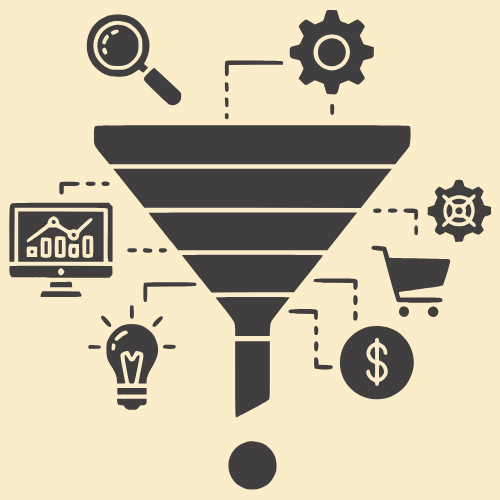
The funnel has three broad stages: awareness, consideration, and decision.
Awareness content addresses broad problems and questions.
Consideration content helps buyers evaluate options and understand categories more deeply.
Decision content handles the final objections and comparisons that happen right before a purchase.
Most brands over-invest in one stage and neglect the others, which creates gaps where potential buyers fall through.
Here’s to fix that:
- Audit your existing content and tag each piece by funnel stage.
- Then look at where the gaps are. If everything you’ve published is either top-of-funnel education or bottom-of-funnel product pages, you’re likely losing
- buyers in the middle. That’s the consideration stage where decisions actually start forming.
- Build content that targets each stage deliberately.
- Use keyword research to understand what questions buyers ask at each point in their journey.
- Create content that answers those specific questions without jumping ahead.
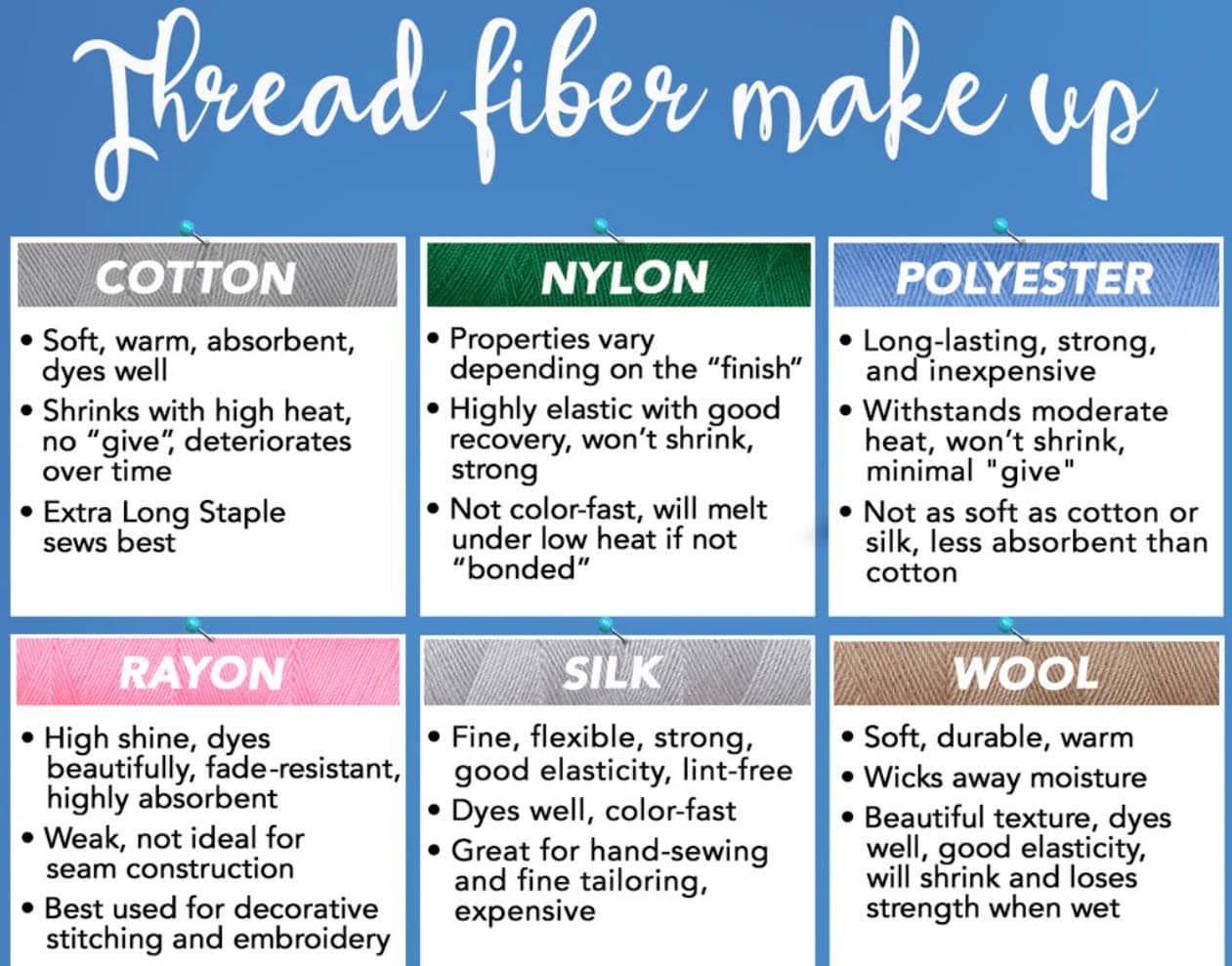
Sewing Parts Online, a retailer selling sewing machines, parts, and supplies, does this well with their “Ultimate Guide to Understanding Sewing Thread.”
This guide is clearly aimed at someone mid-funnel. These readers already sew. They need thread, but they’re not sure which type fits their project. The guide answers that without rushing toward a sale.
That’s exactly the kind of content that keeps buyers moving in the right direction.
Source: sewingpartsonline.com
It Aligns Messaging Across Pages and Channels
Buyers don’t move through your funnel in a straight line. They read a blog post, visit a product page, see a social post, come back a week later, and maybe then convert.
If each of those touchpoints feels like it came from a different brand (different tone, different terminology, different value proposition), that inconsistency creates friction, which is known to kill conversions quietly.
Messaging alignment won’t make every piece of your content sound identical. It will only show that the core positioning, the language you use to describe your product, and the promises you make stay consistent no matter where a buyer encounters you.
When someone moves from a blog post to a product page and the transition feels seamless, that’s alignment working correctly.
Here’s how to build it practically:
- Start with a simple internal style guide that captures your key value propositions, the terms you use for your product category, and the tone your brand carries.
- Use that as a reference when creating any content.
- Then, audit your existing pages. Take a look at your blog posts, product descriptions, and landing pages, and try to spot contradictions or gaps in how you’re describing what you do and why it matters.
- Internal linking is also a useful alignment tool. When your blog posts connect naturally to relevant product pages and vice versa, you’re guiding buyers through a coherent narrative. This is also substantially beneficial for SEO.
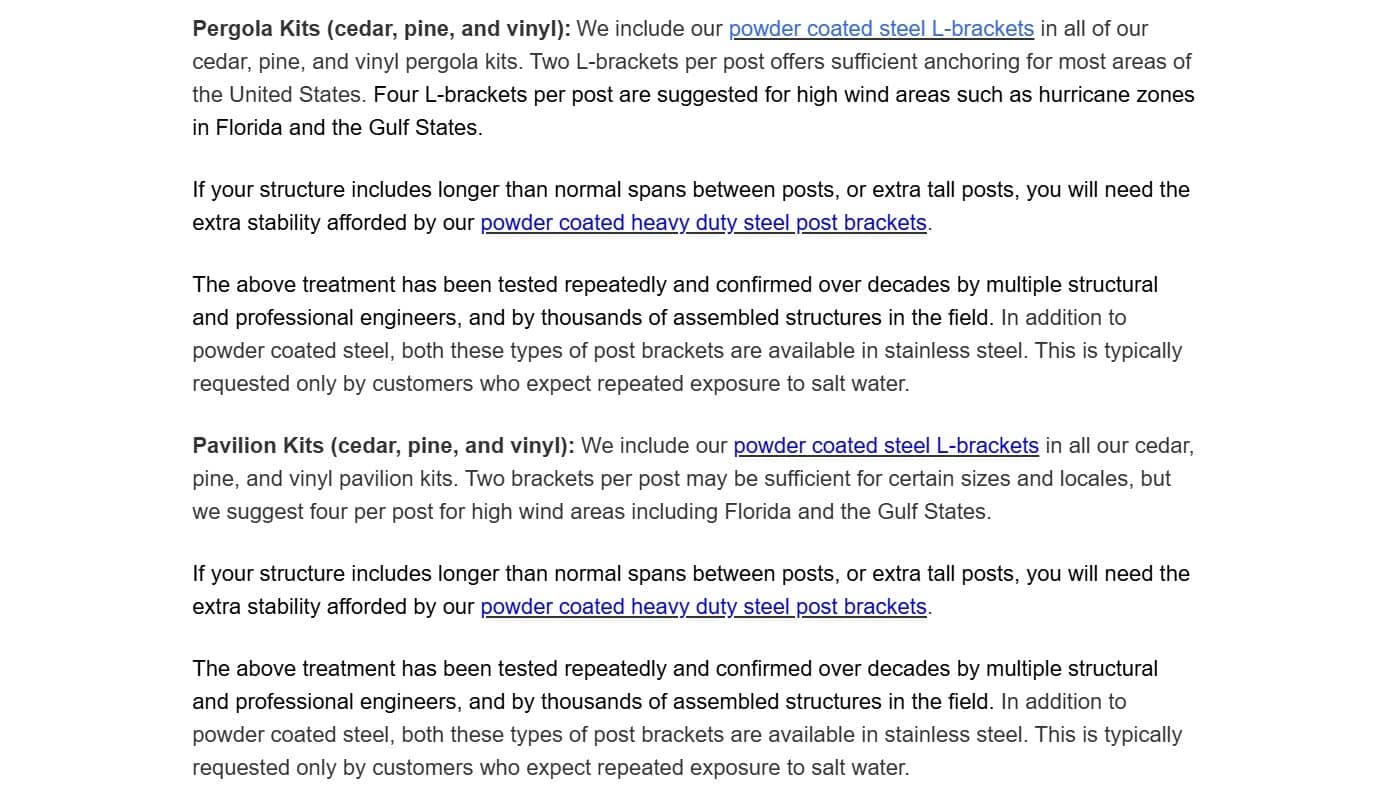
A brand demonstrating how to do this is Pergola Kits USA, a company that designs and sells ready-to-assemble pergola and pavilion kits.
Their learning center functions as a knowledge hub that mirrors the same terminology and positioning found across their product pages. Heavy internal linking keeps readers moving between educational content and product detail without any jarring shift in messaging.
The whole site pulls in the same direction.
Source: pergolakitsusa.com
It Guides the Reader Toward a Logical Next Step
Good content that ends with nowhere to go is a missed opportunity. Readers who’ve just spent time with a well-written, helpful piece are often in exactly the right headspace to take action. That only happens if you give them a clear and sensible path forward.
The timing of a CTA changes everything. Drop it too early, and it feels like a sales pitch wearing an educational costume. Place it at the right moment (after the reader has genuinely absorbed something useful), and it feels less like a demand and more like an obvious move.
For instance, a reader who has just finished an educational article isn’t necessarily ready to buy, but they might be ready to explore further, book a consultation, or browse a relevant product category.
The implementation here requires intentionality:
- End every piece of content by asking one question: What would a reader naturally want to do next after reading this?
- Then make that the CTA.
- If the content covers a problem, link to something that addresses the solution. If it covers a category, link to a relevant product or service page.
- Keep the ask specific, low-pressure, and proportionate to the content that came before it.
Phantom Screens, a company that makes retractable screen solutions for homes and outdoor spaces, gets this right in their “Top 4 Reasons to Get Motorized Retractable Screens” post.
This article builds a genuine case for the product through useful, concrete reasoning. Then, only after the reader has absorbed that, it invites them to find their nearest location and speak with an expert.
The CTA lands at exactly the moment when acting on the information feels like the natural thing to do.

Source: phantomscreens.com
Final Thoughts
None of the above advice requires a complete rewrite of your content strategy overnight. It doesn’t demand a bigger budget or a larger team either. It only asks for intention.
Look at what you are already publishing and ask the hard questions:
- Does this teach before it sells?
- Does it answer the objection the reader is too polite to voice?
- Does it build trust slowly or demand it all at once?
- Does it match where the reader actually stands?
- Does it sound like the same company across every page?
- Does it point somewhere useful when the reader reaches the end?
Answer these questions with intent and start treating every piece of your content like a quiet conversation with someone who might eventually become a customer.
When you write with that mindset, the metrics tend to take care of themselves. Traffic becomes secondary to whether the right people are finding you. At the same time, conversions become a natural outcome of being helpful rather than a goal you chase.
Other Interesting Articles
- AI LinkedIn Post Generator
- Gardening YouTube Video Idea Examples
- AI Agents for Gardening Companies
- Top AI Art Styles
- Pest Control YouTube Video Idea Examples
- Automotive Social Media Content Ideas
- AI Agent for Plumbing Business
- Plumber YouTube Video Idea Examples
- AI Agents for Pest Control Companies
- Electrician YouTube Video Idea Examples
- AI Agent for Electricians
- How Pest Control Companies Can Get More Leads
- AI Google Ads for Home Services
- Best AI Video Generator Platforms
Master the Art of Video Marketing
AI-Powered Tools to Ideate, Optimize, and Amplify!
- Spark Creativity: Unleash the most effective video ideas, scripts, and engaging hooks with our AI Generators.
- Optimize Instantly: Elevate your YouTube presence by optimizing video Titles, Descriptions, and Tags in seconds.
- Amplify Your Reach: Effortlessly craft social media, email, and ad copy to maximize your video’s impact.
The post Common Traits of Content That Supports the Sales Funnel appeared first on StoryLab.ai.
Deixe um comentário