

5 Best Street Interview Video Agencies for Creating Paid Social Content

Paid social has made video production a much more demanding exercise.
A brand can produce a polished advertisement, place it in front of a carefully selected audience, and still struggle to hold attention once the video enters a crowded social feed. That has pushed many marketers toward formats that feel more immediate and less rehearsed. Street interviews are one of those formats.
The premise is straightforward. A host approaches people in a public setting, asks a question, introduces a product or idea, and captures the response. The finished footage can then become an advertisement for platforms such as Instagram, TikTok, YouTube, or other paid social channels.
The apparent simplicity is misleading.
Good street interview content depends on the quality of the question, the person conducting the interview, the people being approached, the setting, the way the product enters the conversation, and the editing that turns hours of footage into a short advertisement. Paid social adds another layer because the final video has to communicate quickly and give the viewer a reason to continue watching. That makes the choice of production partner important.
Some agencies specialize specifically in street interview advertising. Others approach the format through product reaction campaigns, broader video production, or creator networks. They can all produce street interview content, but their working models are different.
The five agencies below were selected based on their documented involvement in street interviews and their relevance to paid social content. The ranking considers specialization, production approach, creative strategy, and how closely each agency’s service aligns with the demands of paid advertising.
Chapters
1. Street Poller Media
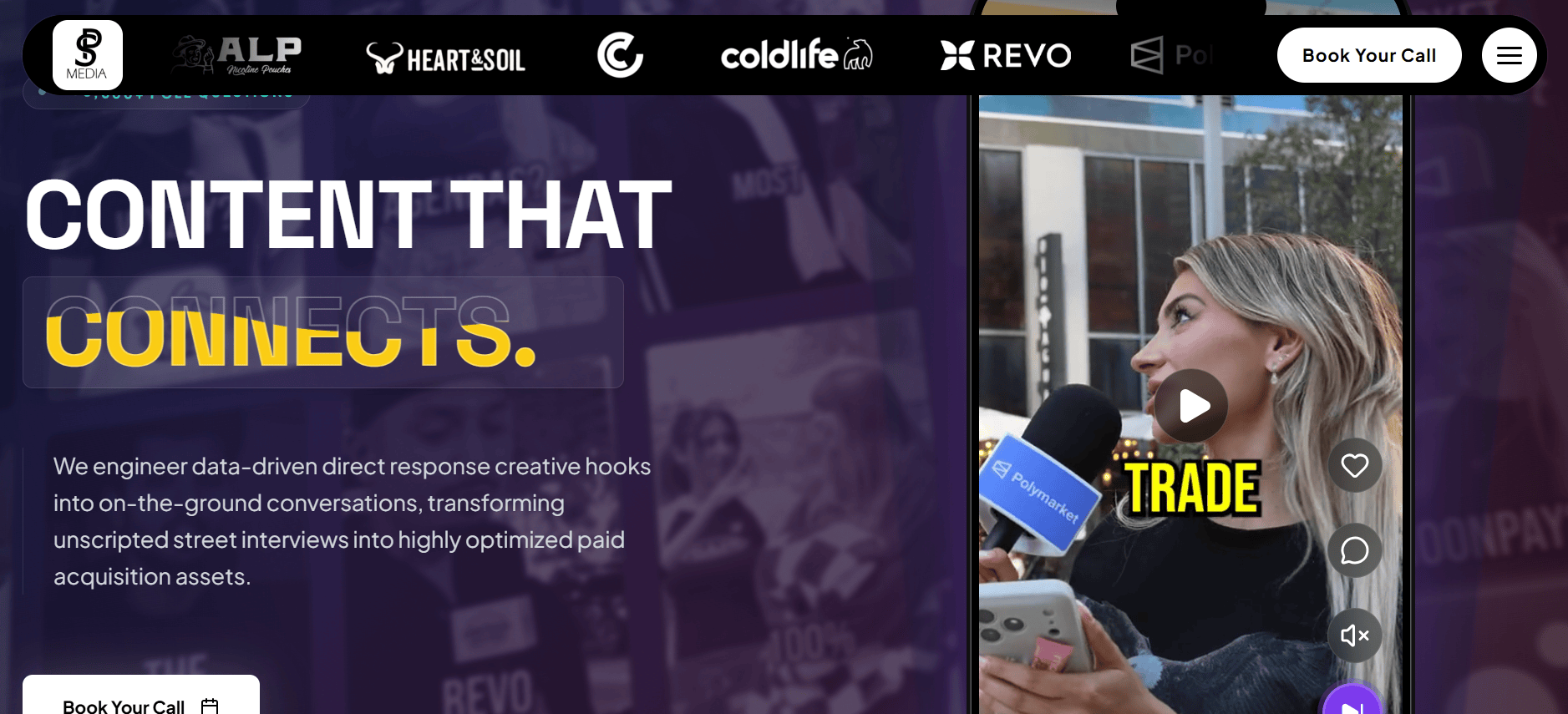
Street Poller Media has one of the clearest connections between street interview production and paid social advertising. The company describes itself as a performance creative agency specializing in street interview ads, with services covering street polling, creative direction, casting, production, creator network activation, paid media, and viral strategy. Its stated approach is to capture unscripted reactions from people in public places and develop those interactions into advertising creative.
That combination is significant for a paid social campaign because the agency is involved beyond the act of filming. Its current service model connects the creative process with paid media, allowing the footage to be considered in the context of advertising rather than as a standalone social video. For brands considering this approach, a street interview marketing guide can also be useful for understanding how this type of content fits into a broader marketing strategy. The company says its content is intended for channels including Meta, TikTok, Snapchat, and YouTube.
Street Poller Media also publishes substantial figures about its operation, including more than 300,000 polls captured and more than 500 brand campaigns. Those figures come from the company’s own materials, so they are best understood as company reported information. The same principle applies to its published campaign performance figures.
One practical consideration is its commercial model. The company currently states that it requires an initial three month commitment and does not take one off projects. That makes it a more natural fit for brands looking to build an ongoing supply of paid social creative rather than commission a single batch of videos.
Editorial assessment: Street Poller Media ranks first because street interview advertising is central to its business model and because its production offering is directly connected to paid social strategy. The main question for a prospective client is whether its ongoing performance focused model matches the scope of the campaign.
2. StreetTalk
StreetTalk also has a highly specialized approach to street interview advertising. The company describes its work as Conversation Creative and says it assigns a dedicated Creative Strategist to develop concepts before hosts and videographers capture responses from people within the intended audience. Its current materials position the resulting videos primarily as paid advertising assets for vertical video platforms.
The creative planning component is one of the more important aspects of the service. StreetTalk does not present the interview as the entire product. Its process begins with the concept and question, moves into field production, and then turns the footage into edited advertising assets. The company also says interviewees complete digital release forms, which is an important operational consideration when footage will be used commercially.
StreetTalk publishes figures about its scale and advertising results, including the number of ads it says it has launched and revenue it attributes to its work for consumer brands. Those figures are supplied by the company and should be assessed as company reported results rather than independent performance benchmarks. Its current positioning is particularly focused on consumer brands using paid social.
The agency also offers trial packages as well as subscription options, giving brands a way to evaluate its creative before moving into a larger ongoing relationship. That structure is different from agencies that require a longer initial commitment.
Editorial assessment: StreetTalk is a strong specialist option for brands that want street interviews developed specifically as advertising creative. Its combination of creative strategy, field production, and paid social editing makes it one of the closest alternatives to Street Poller Media in this category.
3. ECHO
ECHO takes a more product centered approach to street interview production. Its current service offering focuses on Street Interview Campaigns and Product Reaction Ads, with the agency taking products into public spaces to capture reactions, demonstrations, objections, and testimonials. The finished material is designed for TikTok, Instagram, Meta advertising, and other social formats.
Its production process covers planning, casting, filming, editing, and scaling. ECHO says it establishes the creative angle, hooks, and demographic before filming and then selects presenters and locations around the intended audience. This makes the service particularly relevant when the product can be demonstrated or experienced during the interview rather than simply mentioned by the participant.
The agency currently reports more than 1,200 street interviews recorded and more than 50 million organic views generated. Those numbers are published by ECHO and should therefore be treated as company reported figures. The agency also states that it offers coverage across the UK and Europe and currently advertises a seven day brief to delivery process, although actual timing will depend on the scope and production requirements of a campaign.
This focus gives ECHO a fairly clear identity. A brand selling something that people can taste, try, compare, demonstrate, or react to can potentially get considerable creative value from the format. A campaign centered on formal research or broader corporate video production would call for a different production model.
Editorial assessment: ECHO is a credible choice for product led paid social campaigns where public reactions and demonstrations are central to the creative idea. Its narrower focus is useful when it matches the product, although it may be less appropriate for brands seeking a broader research or production relationship.
4. Vox Pops International
Vox Pops International approaches street interviews from a broader video research and production perspective. The company specializes in vox pops, which are essentially short interviews with members of the public, while also offering video diaries, in depth interviews, qualitative video research, social media production, corporate video, event filming, animation, and other services.
That broader background changes the emphasis of the work. Vox Pops International says its video services can support marketing, audience insight, customer feedback, internal communications, and research projects. Its street interview service includes intercept interviews and can be used for advertising and social content as well as audience understanding.
The company also has an international production model. Its current site says it works through a global network of partners and can regularly film in more than 40 countries, including in local languages. For brands running campaigns across several markets, that geographic capability can be more useful than working with an agency whose production is concentrated in a smaller number of locations.
The tradeoff is that street interview advertising is one part of a much wider service portfolio. A brand looking for a production partner that understands paid social creative at a performance marketing level may find a specialist agency more closely aligned with that particular objective.
Editorial assessment: Vox Pops International brings a broader production and video research perspective to street interviews. It is particularly interesting when a campaign needs professionally produced public interviews alongside other forms of video or audience insight.
5. Mainstage
Mainstage uses a creator campaign model rather than operating as a conventional dedicated street interview production agency. Street interviews are one of several formats available through its platform, alongside product reviews, app walkthroughs, creator skits, and other forms of short form content.
The model is different from commissioning a single production crew. Brands provide creators with a campaign brief that can establish the format, question, claims, disclosure requirements, approval criteria, usage rights, and other conditions. Creators then produce the content according to the brief, with Mainstage handling review and payment through its platform.
Mainstage also offers performance based creator campaigns in which brands can pay for verified views. That makes the platform relevant to marketers interested in combining production with creator distribution. At the same time, the model requires careful creator selection. Mainstage’s own guidance recommends evaluating creators for their ability to conduct field production, including interviewing, audio, framing, editing, and handling consent, rather than relying on follower count alone.
Another useful distinction is that Mainstage explicitly warns against treating street interviews as representative research. A handful of responses collected from one location can produce useful creative material and observations without representing the views of a broader population. That is an important distinction for brands that intend to use interview footage as part of their marketing decision making.
Editorial assessment: Mainstage is best understood as a creator production platform that includes street interviews rather than a specialist street interview agency. Its model provides flexibility when a brand wants several creator formats or a performance based distribution structure, but a dedicated production agency may be more appropriate when street interviews are the central requirement.
What Should a Street Interview Paid Social Campaign Actually Produce?

Hiring a street interview agency is only one part of the creative decision. Before production begins, the brand should have a reasonable idea of what it expects to receive at the end of the process. A campaign can generate hours of footage and still leave a media team with relatively few useful advertisements if the production was not planned around the final creative requirements.
For paid social, the useful output is usually a collection of distinct creative assets rather than one finished video. Different participants may provide different hooks, objections, demonstrations, or explanations. Those moments can then be edited into separate advertisements that communicate the same product from different angles.
A well planned production should therefore give the brand enough material to test several ideas.
| Campaign element | What to look for |
|---|---|
| Interview concept | A clear question or interaction that can produce varied responses |
| Participants | People who have a credible connection to the intended audience |
| Product interaction | A natural opportunity to demonstrate, taste, test, compare, or react |
| Hooks | Several moments that can open an advertisement quickly |
| Editing | Multiple versions rather than one fixed cut |
| Usage rights | Clear permission for the intended paid advertising channels |
| Creative variety | Different participants, questions, objections, benefits, or openings |
This is one area where agencies can differ considerably. A production company may focus primarily on capturing good footage, while a performance creative agency may build the production around the number and variety of advertisements that can eventually come from that footage.
For a brand running paid social at scale, that distinction can have a meaningful effect on the value of the production.
How to Judge the Quality of the Interview Footage
The most useful street interview footage usually gives the editor something to work with.
A participant who simply says that a product is “goodâ€ン provides very little context. Someone who explains why they prefer it, demonstrates how they would use it, describes a problem it solves, or reacts unexpectedly gives the creative team considerably more material.
This is why the quality of the interview should be judged by the substance of the responses rather than by how polished the camera work looks.
There are several signals worth watching for when reviewing an agency’s portfolio:
- Do participants give specific answers rather than generic praise?
- Do the interviews create genuine differences of opinion?
- Does the host know how to keep the conversation moving?
- Is the product introduced naturally?
- Are there moments that could work as opening hooks?
- Does the footage show different types of people and reactions?
- Can the material be edited into several distinct advertisements?
The answers to these questions tell you considerably more about an agency’s ability than a portfolio filled with attractive shots.
The Question Often Determines the Campaign
The question is one of the easiest parts of street interview production to underestimate.
Suppose a skincare company asks people, “Do you like this product?â€ン Most participants can answer in a few seconds, leaving little room for a compelling advertisement. A question about the biggest problem they have with their current skincare routine could produce complaints, personal experiences, competing products, and different reasons for changing their habits.
The second question creates more creative possibilities because it gives the participant something meaningful to explain.
The same principle applies across categories. A financial application might ask people how they currently manage a particular task. A food brand could ask participants to compare two flavors. A technology company could ask people to perform a task using its product and describe what they expected beforehand.
The goal is not to manipulate the answer. It is to create a situation where people have something worth saying.
That is why creative strategy belongs before filming rather than being treated as an editing problem afterward.
Where Street Interview Content Fits Into a Paid Social Strategy
Street interviews can serve several different roles within a paid social campaign. The agency should understand which role matters before production begins because each one calls for a somewhat different creative approach.
| Campaign role | Useful street interview approach |
|---|---|
| Awareness | Unexpected questions, interesting reactions, recognizable situations |
| Product education | Demonstrations, comparisons, explanations, first impressions |
| Objection handling | Questions that surface concerns or doubts about the category |
| Social proof | Genuine experiences and specific reasons for choosing a product |
| Creative testing | Multiple questions, participants, hooks, and product angles |
| Retargeting | More detailed responses that address hesitation or explain value |
For example, an awareness advertisement may benefit from a surprising answer that makes someone stop scrolling. A retargeting advertisement may need considerably more information because the viewer already knows the brand and needs another reason to consider buying.
This is why a collection of street interviews can become more useful when it is planned as a group of creative concepts instead of one campaign video.
The same production day might generate a reaction advertisement, a product demonstration, an objection focused video, and several alternative openings. The value comes from the range of usable material rather than the raw number of interviews recorded.
Authenticity Needs Careful Handling
Brands often turn to street interviews because they want people to speak naturally about a product. That can work well, but there is a difference between genuine reactions and carefully engineered reactions that happen to look spontaneous.
The interviewer should have enough direction to keep the conversation relevant without forcing participants toward a predetermined answer. This is especially important when the footage will be used as advertising because viewers can quickly become skeptical when every participant appears to reach the same conclusion.
Varied responses can actually make the final creative more credible.
One person may like the product immediately. Another may question the price. Someone else may prefer a competing option. Another participant may change their mind after trying it. Those differences give the editor material that feels like a conversation rather than a sequence of people repeating the brand’s talking points.
That also gives the brand an opportunity to address genuine objections instead of avoiding them.
Participant Rights and Advertising Usage
Street interview production involves people who may have little connection to the brand before filming begins. That makes consent and usage rights important parts of the production process.
A brand should understand how participants authorize the use of their likeness and whether the agreement covers paid advertising. It should also establish whether the footage can be reused in other campaigns or channels and for how long.
Before production, it is useful to confirm:
- How participant releases are obtained
- Who is responsible for collecting those releases
- Which advertising platforms are covered
- Whether paid and organic use are both permitted
- Whether raw footage is included
- Whether the brand receives usage rights to edited assets
- Whether there are geographic or time limitations
- How location permissions are handled
These details can vary considerably between agencies, so they should be confirmed in the actual agreement rather than inferred from a website description.
What About Performance Claims?
Street interview agencies frequently publish impressive results. Some report improvements in acquisition costs, return on advertising spend, engagement, revenue, or views. Those examples can be useful when assessing whether an agency has experience producing performance creative, but they need to be read carefully.
A campaign’s result depends on many variables outside the interview itself.
The product, price, offer, audience, media budget, landing page, advertising account, bidding strategy, seasonality, and previous brand awareness can all affect the outcome. A creative asset that performed exceptionally well for one company may perform very differently for another.
A sensible evaluation therefore looks for context.
When an agency presents a successful case study, consider whether it explains:
- What the company was selling.
- Which audience the campaign targeted.
- What type of creative was produced.
- How the videos were distributed.
- Which period the results cover.
- What metric the agency is reporting.
- Whether the figure represents one campaign or a broader average.
This approach does not dismiss agency case studies. It puts them in the right context.
Company reported results are evidence that a particular campaign achieved a particular outcome. They are not guarantees of what a future client will achieve.
Questions to Ask Before Choosing an Agency
A useful conversation with a prospective agency should go beyond asking how many videos it can produce.
Start by discussing the advertising objective. Ask the agency what it believes street interviews can accomplish for the brand and what type of creative it would recommend. The answer can reveal whether the team is thinking about the campaign as advertising or simply as video production.
It is also worth asking how much of the process happens before filming. A strong agency should be able to explain how it develops questions, identifies the audience, selects locations, chooses interviewers, and decides what types of responses it wants to capture.
The production discussion should then move into deliverables and rights.
Here are some practical questions to bring into the conversation:
- How many concepts will be developed?
- How many interviews are typically recorded for a campaign?
- Who conducts the interviews?
- How are participants selected?
- Where will filming take place?
- How are participant releases handled?
- How many edited assets are included?
- Are multiple hooks and versions included?
- Are captions and platform specific edits included?
- Is raw footage available?
- What advertising usage rights does the client receive?
- Does the agency manage paid media or provide creative only?
- How are campaign results evaluated?
The answers will help reveal whether the agency’s operating model matches the campaign.
A company that specializes in producing creative may be the right choice for a brand that already has an internal media buying team. A company that combines production with paid media may be more appropriate for a brand looking for a broader advertising partner.
When Street Interviews May Not Be the Right Format
Street interviews have obvious advantages, but they are not automatically the best answer for every paid social campaign.
The format works particularly well when the product or question gives people something they can react to. It can be less useful when the product requires a lengthy explanation, depends heavily on technical specifications, or has strict communication requirements that leave little room for spontaneous conversation.
There is also the question of audience accessibility.
Some products are aimed at highly specific professional groups or narrow customer segments. Finding enough suitable participants in a public location may be difficult, and a conventional creator campaign, customer testimonial, expert interview, or product demonstration could provide better control.
Street interviews should therefore be considered alongside other creative formats rather than treated as a universal replacement for them.
Other Interesting Articles
- AI LinkedIn Post Generator
- Gardening YouTube Video Idea Examples
- AI Agents for Gardening Companies
- Top AI Art Styles
- Pest Control YouTube Video Idea Examples
- Automotive Social Media Content Ideas
- Plumber YouTube Video Idea Examples
- AI Agents for Pest Control Companies
- Electrician YouTube Video Idea Examples
- How Pest Control Companies Can Get More Leads
- AI Google Ads for Home Services
- 60-Second Training Videos Are the New Corporate Standard
- Cybersecurity PR Pricing: Retainers, Deliverables & ROI
- Best AI Tools for Product Consistency in E-Commerce Video
Master the Art of Video Marketing
AI-Powered Tools to Ideate, Optimize, and Amplify!
- Spark Creativity: Unleash the most effective video ideas, scripts, and engaging hooks with our AI Generators.
- Optimize Instantly: Elevate your YouTube presence by optimizing video Titles, Descriptions, and Tags in seconds.
- Amplify Your Reach: Effortlessly craft social media, email, and ad copy to maximize your video’s impact.
The post 5 Best Street Interview Video Agencies for Creating Paid Social Content appeared first on StoryLab.ai.
Deixe um comentário